
3D printing online: what you need for a reliable quote
File, dimensions, material, quantity, tolerances and finish: the information that transforms an automatic estimate into a truly comparable 3D printing quote.
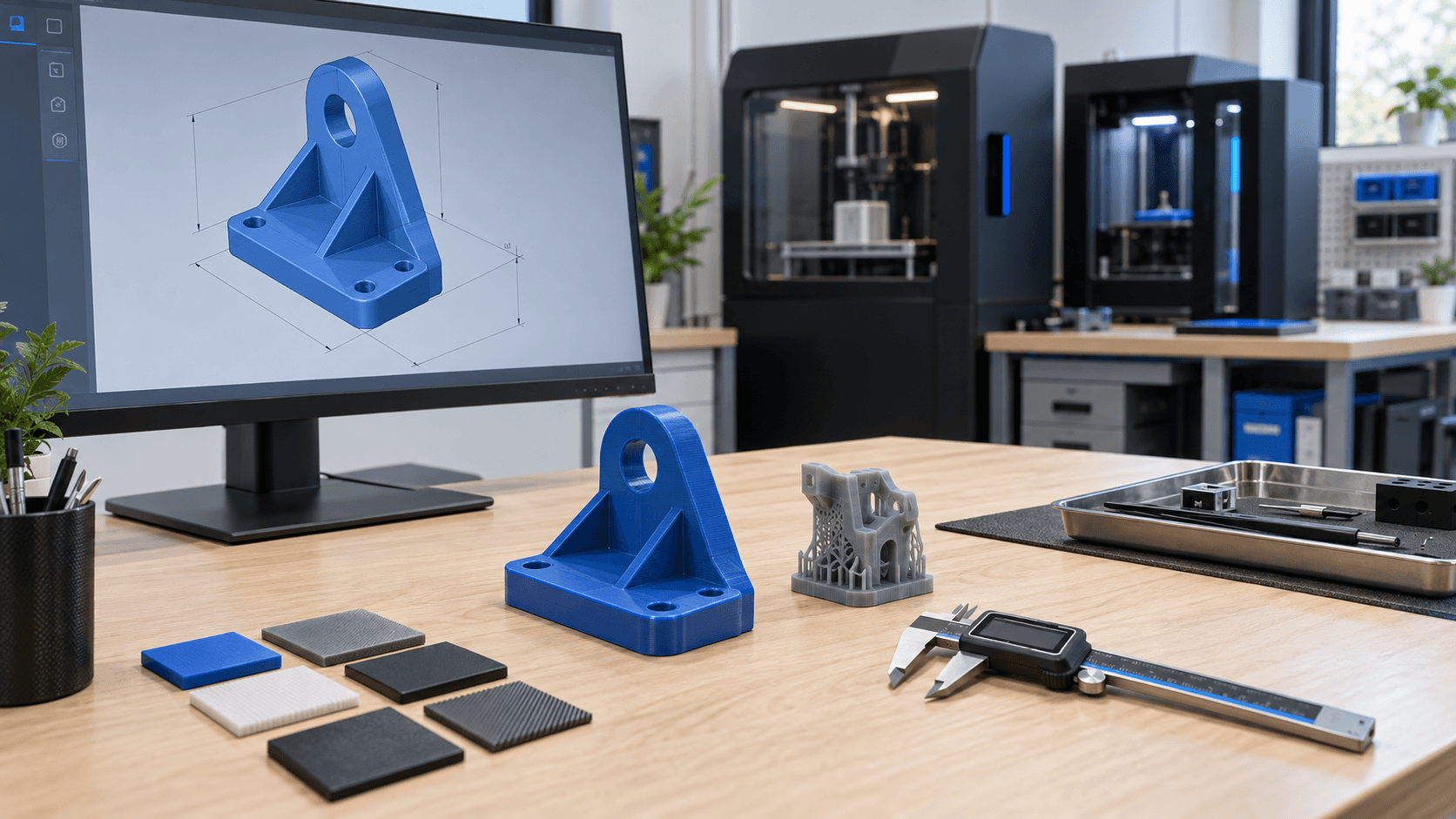
An instant price is not yet a production specification
Loading a file and getting a figure in a few seconds is helpful for orientation, but it doesn't mean that every aspect of the component has already been verified. A configurator can calculate volume, size, material and standard parameters; it is difficult to know the function, critical surfaces, couplings, loads or expected aesthetic result on its own. Two identical files can therefore require different processes and generate different estimates. A reliable request links geometry and use. Before comparing prices you need to make sure that the suppliers are quoting the same part, with the same technology, the same material and the same level of finish and control. Otherwise the lower number may simply exclude a necessary task.
Start from an intact file and the correct scale
The model must represent a closed volume, without open surfaces, overlapping bodies or accidentally internal details. An automatic repair can make the mesh processable, but it does not guarantee that the result matches the design. Before uploading, check the overall dimensions, thicknesses, holes and number of components. Enter at least one reference dimension in the request. The STL format describes a triangulated surface but does not reliably incorporate all design information; in particular, the workflow must clarify the unit of measurement. A 3MF file can store units and more manufacturing data, while a CAD format like STEP helps when the supplier needs to verify or modify geometric features. Don't just send a screenshot: you need the agreed three-dimensional file and, when useful, a drawing with the truly critical dimensions.
Explain what the piece is supposed to do
“Printing in plastic” is not a sufficient requirement. Indicate whether it is an aesthetic mock-up, assembly test, template, casing, bracket or final component. Specify internal or external environment, temperature, humidity, contact with substances, type and direction of loads and expected life. This information guides the choice between FDM, resin and other processes, as well as material selection. Avoid generic requests such as "the strongest material." Rigidity, toughness, temperature, wear and dimensional stability respond to different needs. For regulated applications, food contact, medical use, fire or safety, specific documents and processes are needed: a declaration on the raw material does not automatically make the printed part qualified.
Quantity and repeatability change the job
A single prototype and a series of fifty pieces are not the same multiplied order. The quantity influences layout on the print bed, batch risk, controls, packaging and convenience of dedicated equipment. Indicate the initial quantity, possible reorder and date actually needed. If the project is still evolving, separate the validation sample and the production batch. Also ask how repeatability is handled: file version, material and color, orientation, profile, post-processing and acceptance criteria. A unit price may decrease with a better organized batch, but the effect depends on technology, geometry and available capacity. Do not apply generic percentages without a dimensiontion referring to the real case.
Geometry, orientation and supports affect the cost
Protolabs identifies build and finish time as major cost drivers in additive manufacturing. Workpiece volume and height, orientation and support structures can increase machine time and manual labor. Formlabs also includes equipment, consumables and labor in the cost per part calculation. The weight of the material alone, therefore, does not describe the entire process. A very tall component may require multiple layers; a complex overhang can generate supports to print and remove; closed cavities can trap material or make cleaning impossible. Ask the supplier to propose the orientation, but state which faces are cosmetic, which ones mate, and in which direction the load will act. Reducing support should not compromise strength or functional accuracy.
Tolerances and finish must be localized
Writing "maximum precision" forces interpretations and can lead to unnecessary checks. Instead, mark the diameters, center distances, flatness or clearances that determine the assembly, leaving the non-critical dimensions as standard. Tighter tolerances may require dedicated orientation, finer layers, samples or subsequent machining; Protolabs reminds you that overtolerance can increase time and cost without improving function. Define the finish with the same method. “Smooth” can mean simple removal of supports, sanding, priming, painting or professional treatment. Indicate color, visible faces and unacceptable defects. For a comparable quote, each vendor must include the same level of post-processing.
Read what the quote really includes
A clear proposal should identify file version, process, material, color, quantity, finish, expected checks, indicative times and validity of the offer. Check if file preparation, mesh repair, supports, post-processing, packaging and shipping are included. Also check how non-producible files or subsequent modifications are handled. Slicer estimates remain useful: PrusaSlicer shows expected time and consumption after slicing. However, they are calculated on the selected profile and do not replace machine availability, manpower, waste, control and logistics. For this reason, a professional estimate may differ from the simple multiplication of grams and price of the material.
A checklist reduces revisions and surprises
Before sending the request, prepare: 3D file in the correct scale; amount; final dimensions; function; environment; loads; desired material or required properties; aesthetic surfaces; critical dimensions; finish; target date and delivery address. Add photos of the assembly when they help understand the assembly, without replacing dimensions and CAD. If you want to reduce the cost, ask for a manufacturability-oriented review. Lightening non-functional volumes, avoiding trapped supports, dividing the model intelligently or concentrating tolerances where they are needed can be more effective than simply choosing the cheapest material. However, each modification must be validated with respect to the function. ADIVO can verify files, requirements and technology before formulating the proposal. Send model, quantity and intended use: you will receive a consistent evaluation with material, orientation, finish and necessary checks, with possible sample before production.