
3D models with artificial intelligence: from prompt to a truly printable file
From AI generation to the physical part: controls on mesh, scale, thicknesses, supports and sample proofing to make a 3D model truly printable.
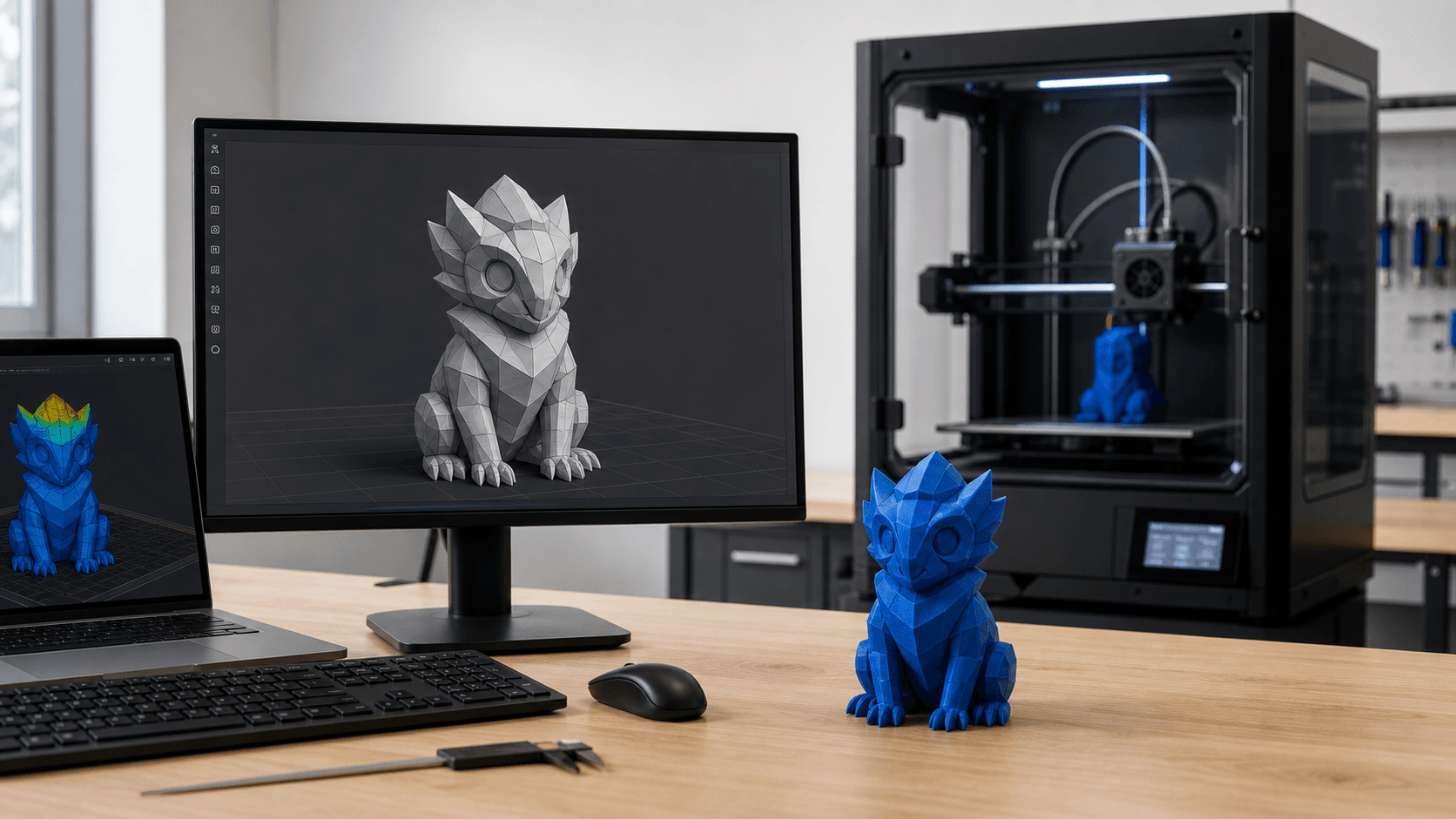
Generating a shape does not mean having designed a piece
Artificial intelligence tools can transform text or an image into a three-dimensional mesh in minutes. It is a useful step for miniatures, decorative elements, concepts and first explorations of form. The file obtained, however, is not automatically ready for production. An image suggests the appearance of an object, but contains no firm information about depth, actual dimensions, fits, loads, or hidden surfaces. The distinction is important: AI generates plausible geometry, while a functional component requires measurable requirements. If the model must fit into a seat, support a weight or be assembled, dimensions and tolerances must be defined in CAD and verified on the piece. For an aesthetic subject, however, the work focuses above all on legibility of details, stability, orientation and finish.
Closed surface and consistent geometry
The first check concerns the integrity of the model. The mesh should bound a closed volume, with no holes, overlapping faces, inconsistent normals, or non-manifold edges. Slicing software can correct some errors, but automatic repair does not guarantee that the final shape respects the original intent. After each intervention it is advisable to compare the preview, sections and volume with the starting model. Even invisible internal details can create problems: interpenetrating bodies, suspended shells or unwanted cavities increase time, supports and the risk of defects. Before slicing it is useful to separate the parts, eliminate unnecessary geometries and decide whether the model should be solid, hollow or divided into assembleable components.
Scale and units of measurement
STL describes the surface, but does not impose a unit of measurement. A model may therefore arrive in the software much larger or smaller than expected. The minimum check includes height, width, depth and at least one known reference dimension. For miniatures and decorative objects it is also necessary to check that details, fingers, tips, walls and connections remain printable at the chosen scale. Scale also influences cost and process. Doubling a linear dimension can greatly increase material volume and machine time. Before starting a complete print it is advisable to define the final dimensions and, when possible, create a sample of the most critical area.
Thickness, details and stability
An AI model may appear solid on screen and contain walls that are too thin for the chosen process. FDM and DLP have different capabilities for details, overhangs, surfaces and supports. There is no universal minimum thickness: it depends on material, orientation, part height and function. The control must therefore refer to the actual machine and material. For an object that must stand, the center of gravity and the supporting surface matter as much as the quality of the mesh. A small base, a tall element, or an unbalanced pose may require a dedicated base, a different subdivision, or a more stable orientation. Adding supports without correcting the geometry can increase marks and post-processing without solving the main problem.
Choose between FDM and DLP
FDM is suitable for many medium to large models, prototypes, templates and objects where strength and cost take priority over micro detail. DLP is interesting for miniatures, fine surfaces and geometries where small details must remain legible. The choice does not just depend on aesthetics: material, use, size, quantity, finish and management of the supports come into play. For complex models it may be useful to divide the file into parts with joints, mounting references and hidden surfaces. This reduces supports, improves accessibility during finishing and allows you to reprint only one element in case of modification.
From generated file to validated sample
A reliable flow can be summarized in seven steps: define use and size; generate the concept; repair mesh; check scale and thicknesses; choose technology and orientation; simulate slicing; print a sample. The sample result must be evaluated against explicit criteria: stability, detail, fitment, surface or strength. Artificial intelligence accelerates the creative phase, but does not replace technical preparation. ADIVO can verify files generated from text or image, correct printing issues and prepare an FDM or DLP sample. Send the model along with final dimensions, intended use and desired finish - this is the information needed to transform a digital shape into a manufacturable object.
From model to piece with ADIVO
Have you generated a 3D model with artificial intelligence? Send the file, dimensions and expected result to ADIVO: we will check the printability and set up a first FDM or DLP sample.